A Recap of Public Comment
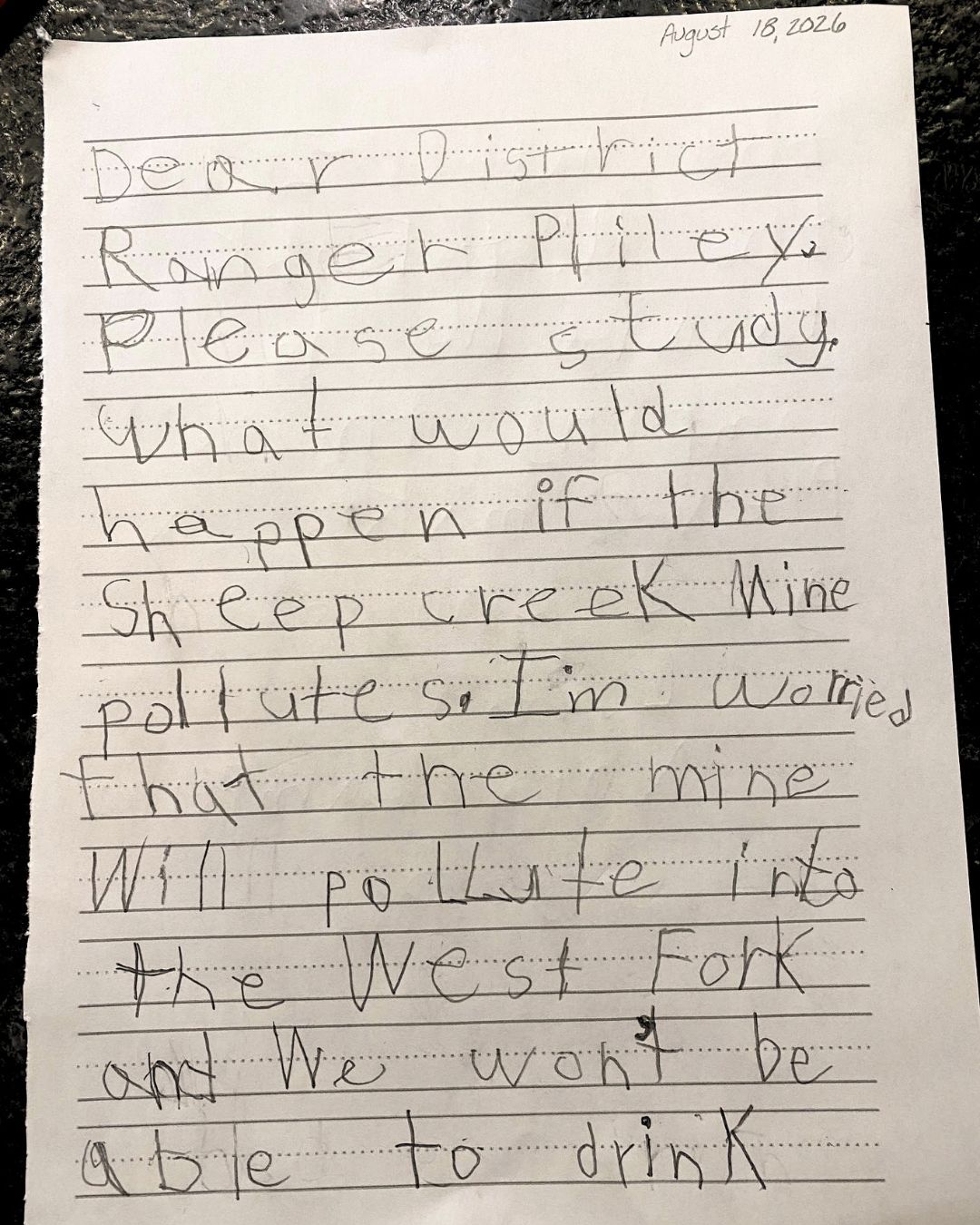
On August 14 the Bitterroot National Forest voluntarily opened a 30-day Public Comment period for the Sheep Creek Mine Exploration Plan. Roughly 6,600 comments were submitted. We read a random sample of 125 comments submitted from local people, mostly made up of residents of Ravalli County and handful of Missoula County.
98% of those comments were opposed to the current state of the Exploration Plan, expressing a range of concerns about potential negative impacts stemming from proposed activities (or lack thereof).
A portion (39%) of comments did not have direct input on the Plan for Exploration, instead expressing a general opposition to the proposal to develop a rare earth mine in the headwaters of the Bitterroot River at all. Though the concerns raised in these particular comments are valid and showcase the extent of public controversy around the proposal, the Forest will focus their review more heavily on comments responding directly to the Plan at hand for the Exploration Phase. The breakdown below also focuses on comments that directly addressed the Plan for Exploration.
Words have been removed from quotes to shorten Public Comment excerpts; no words have been added.
95% of Comments Urge the Forest Service to conduct an Environmental Assessment rather than a Categorical Exclusion.
- “I don’t think the mining project should’ve even been considered from the beginning, but here we are with a project that’s been fast-tracked. The Forest has an opportunity to ensure that a thorough environmental assessment is completed.”
- “I am opposed to approving the Plan without a thorough environmental review. I worked as an exploration geologist for a decade, and never saw exploration done like this… Collecting a 3,000-[ton] sample from underground workings is unheard of. This sounds more like a small mine, especially because there will be substantial tonnage of waste rock generated.
- “Add to that the risk of untested technology and the extraordinary risk to the Bitterroot River, on which life in the Bitterroot Valley depends, there should be no questions that serious analysis is demanded.”
~88% of comments describe specific concerns for waters:
- “As a small farm owner, I rely on water diverted from the Bitterroot River to grow vegetables that feed many people [and provides] my sole income… The current plan does not adequately ensure the safety of the water… or safety for humans and wildlife who rely on this water.”
- “We are worried about any chemicals that may go into the River, resulting in us not being able to use the River for fishing or recreation anymore. I don’t believe there have been enough environmental studies don’t to see what the impact is going to be.”
Most of described concerns about water were based on the nature of the environment in which the proposed Exploration would take place: in the Headwaters of the Bitterroot River.
- “The headwaters of the West Fork of the Bitterroot are far too valuable – and the unanswered water-related questions far too consequential – to proceed without careful environmental review.”
~70% describe explicit concerns for wildlife:
- “The Plan completely omits mention of Bull Trout, despite Forest Service data confirming their distribution throughout the West fork and its tributaries (Sheep Creek). These waters serve as designated spawning habitat.”
- “Air traffic amounting to 3,000 helicopter flights alone will surely have a negative impact on wildlife, recreation, hunting, and general safety.”
Approximately half of comments directly linked their concerns to the potential for hazardous materials in the to-be disturbed rock or lack of appropriate investigation of local geochemistry:
- “The plan completely fails to provide a comprehensive hazardous materials mitigation strategy, a radioactive dust suppression plan, or an emergency spill response protocol for hauling vehicles. We know there is thorium, uranium, arsenic, and more present in the rock.”
- “There is no assurance provided that mined material containing […] asbestos, uranium, and other hazardous substance will be monitored and contained.”
- “The risk of possible asbestos contamination has not been adequately evaluated, putting a “Libby-like cloud” over the project.”
- “No chemical testing is proposed. Rare earth deposits often have asbestos or radioactive elements associated with them. It would be prudent to test for these hazards before blasting and transporting samples on public roads.”
Other prominent concerns about the Exploration Plan included (1) that not enough baseline data has been collected or considered, (2) negative impacts to roads, traffic, and safety, and (3) distrust of the Exploration company, USCM, to act accountably without greater supervision from the Forest Service, and (4) lack of commitment to monitoring.
Not enough baseline data:
- “The USFS cannot rely on flawed or incomplete data. Omitting a specialized baseline hydrological assessment for radioactive runoff from these confirmed thorium-heavy zones is a fatal defect.”
- “The [project] seems like an expedited experiment vs a thoughtful project with appropriate scientific review and objective downside measurement.”
Traffic Concerns:
- “Our roads were not constructed for heavy use. Traffic on the West Fork of the Bitterroot River is generally light with few homes and a narrow roadway adjacent to the River. It was not intended for 6 million pounds of excavated, potentially hazardous rock to be transported by air and by 350 truckloads of material to and from the mine site to Conner in the first year.”
- “The traffic operations are not clearly described for how roads will be improved or maintained and how important aquatic resources that are crossed by or adjacent to roads will be protected from road traffic or potential spills.”
Distrust of USCM:
- “The mining operators are flip-floppers, and a bunch of complete hypocrites with what they say and what they end up doing. Nobody – including the Forest Service – can trust them.”
- “The company does not have a track record of success in safely mining in similar situations. Lack of transparency, “Fast Tracking”, and lack of detail in the Plan … leave more questions than answers… This is a risk we cannot take without rigorous scrutiny on the project.”
- “As a 20+ year resident of Darby, with my husband’s family here for 3 generations… please put more consideration into the long-term effects of this project, and how it will affect our home. I don’t believe that the mining company cares what the local people have to say.”
Lack of Monitoring Commitment:
- “There is no required water quality monitoring for Sheep Creek or the West Fork to assure our waters remain clean and safe.”
- “How can one tell if the water is being harmed without baseline tests and tests during exploration?”
Other
- “The threat of polluting the headwaters of the Bitterroot River is probably as a dumb a thing that I have heard of in my 80 years on Earth.”
The preliminary breakdown here is based on a simple sample of 125 comments, out of roughly ~700 comments we have access to as of 9/23/2026. We look forward to a more complete and rigorous review when the Forest Service shares the complete collection of ~6,600 comments.
The categorized comments were all submitted by community members. You can find comments submitted by practitioners (like the Bitterroot Water Partnership, Montana Trout Unlimited, etc.) on the ‘Updates’ Page, here.